NURVE Block Registry
A National Ultrasound-Guided Nerve Block Registry

















What is the NURVE Block Registry?
The National Ultrasound-Guided Nerve Block Registry
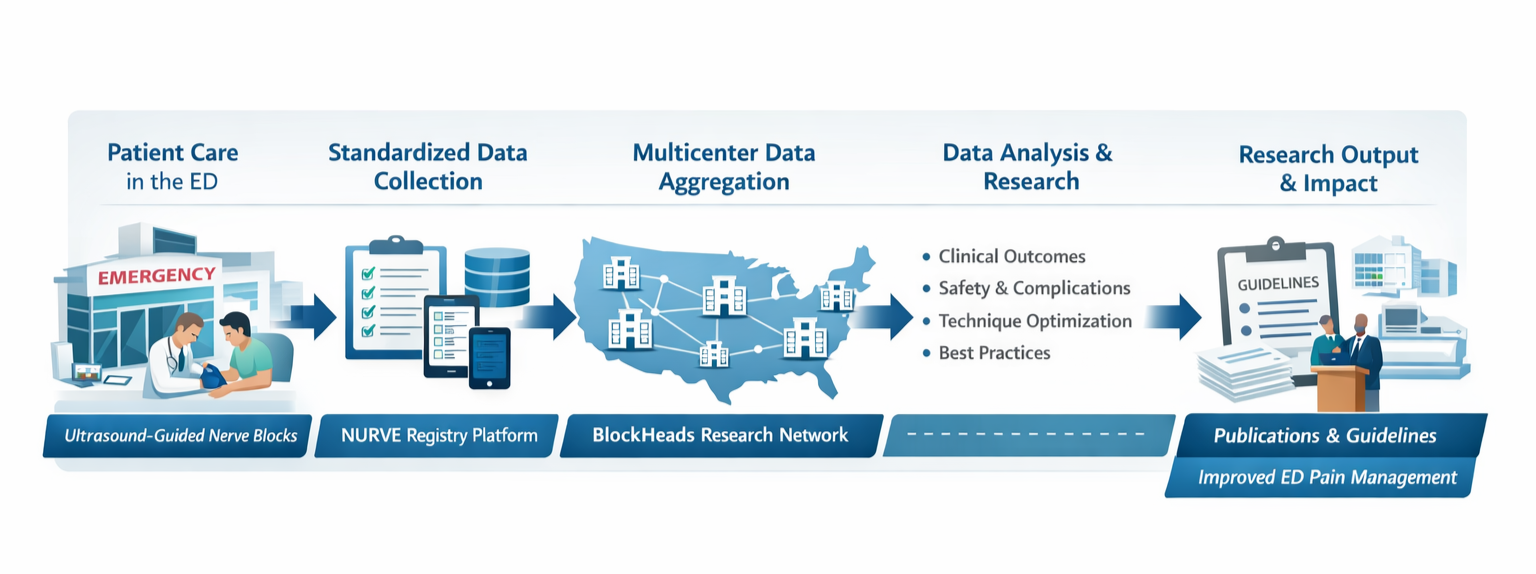
The NURVE Block Registry is a multi-center observational research initiative developed by the founders of BlockHeads to systematically study the use of ultrasound-guided regional anesthesia (UGRA) in emergency medicine practice.
Regional anesthesia is increasingly recognized as an effective, opioid-sparing strategy for acute pain management in emergency medicine. However, the published literature remains limited by small sample sizes, single-center experiences, and procedural heterogeneity. The NURVE Block Registry was established to address these limitations by creating a large-scale, standardized dataset capturing real-world emergency physician–performed nerve blocks.
Participating sites prospectively collect structured data on ultrasound-guided nerve block procedures performed in the emergency department. Key data domains include:
Patient Characteristics
Demographics
Clinical indication for block
Injury or pathology type
Procedural Variables
Block type
Ultrasound technique
Local anesthetic selection and dosing
Adjunct medications
Operator training level
The primary objectives of the NURVE Block Registry are to:
• Generate high-quality multi-center data on emergency physician–performed nerve blocks
• Evaluate safety and effectiveness of UGRA across diverse emergency settings
• Identify procedural best practices and technique optimization
• Support peer-reviewed publications and national presentations
• Establish a platform for future prospective trials and guideline development
By aggregating data across institutions, the NURVE Block Registry aims to create the largest dedicated emergency medicine nerve block dataset, helping to define the role of emergency-directed regional analgesia (EDRA) in modern emergency care.
BlockHeads invites academic centers, community emergency departments, and ultrasound fellowships interested in advancing regional anesthesia research to participate in this collaborative initiative.
Clinical Outcomes
Pain score reduction
Need for rescue analgesia
Procedural success
Complications and adverse events
Operational Impact
Time to analgesia
ED workflow considerations
Procedural efficiency



Research from NURVE Block Registry

Efficacy & Safety of Adjunct Medications in ED US-Guided Nerve Blocks: A National Ultrasound-Guided NeRVE (NURVE) Block Registry Study
A NURVE Registry study examining how adjunct medications used with local anesthetics influence analgesic efficacy, block duration, and safety outcomes in emergency department ultrasound-guided nerve blocks.

Training Level and Analgesic Outcomes of Ultrasound-Guided Nerve Blocks in the Emergency Department: An Analysis From the NURVE Block Registry
A NURVE Registry study examining the relationship between clinician training level and analgesic outcomes following ultrasound-guided nerve blocks performed in the emergency department, helping to better understand how experience and training influence block effectiveness and patient pain relief.

Complication Rates After Ultrasonography-Guided Nerve Blocks Performed in the Emergency Department
A NURVE Registry study evaluating the incidence and types of complications associated with ultrasound-guided nerve blocks performed in the emergency department, helping to better define the safety profile of regional anesthesia in emergency medicine practice.
Clinical Sites in the NURVE Block Registry
Highland Hospital / Alameda Health System
University of Michigan Health
University of Connecticut Health
Brown University Health
Temecula Valley Hospital
University of Arizona - Valleywise Health
Loma Linda University Health
Hennepin Healthcare
University of Colorado Hospital
Denver Health
Mount Sinai Medical Center - MiamiBeach, FL
Baylor University Medical Center
Brigham & Women’s Faulkner Hospital
Lahey Hospital & Medical Center
Brigham and Women’s Hospital
Let’s Work Together
We invite emergency physicians and institutions performing ultrasound-guided nerve blocks to join the National Ultrasound-Guided NeRVE (NURVE) Block Registry.
The registry is a collaborative research effort aimed at advancing the evidence base for regional anesthesia in the emergency department. By contributing data and participating in registry-based studies, collaborators help generate meaningful insights into clinical practice, outcomes, and safety while helping shape the future of emergency department regional anesthesia.
If you are interested in contributing to this growing national collaboration, we welcome you to join the NURVE Block Registry and be part of the ongoing effort to improve pain management through ultrasound-guided regional anesthesia.